Whole-home water repiping addresses systematic failures in vintage residential infrastructure across Los Angeles County. In historic neighborhoods like Silver Lake, Los Feliz, Highland Park, and Echo Park, residences…
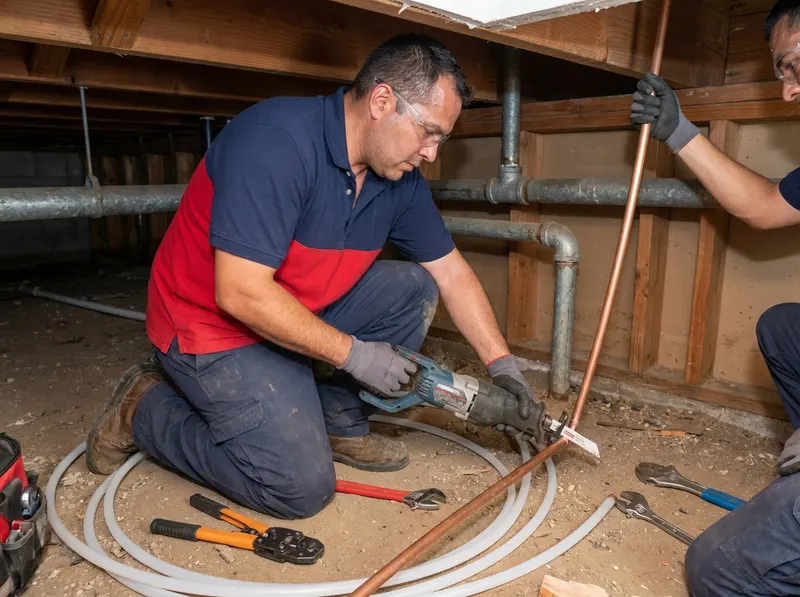
Whole-home water repiping addresses systematic failures in vintage residential infrastructure across Los Angeles County. In historic neighborhoods like Silver Lake, Los Feliz, Highland Park, and Echo Park, residences constructed prior to 1965 frequently operate on original galvanized steel lines. Over decades, these pipes develop internal rust scale that narrows the internal diameter, dropping water volume to multiple fixtures simultaneously and leaching oxidized sediment into drinking supplies. Mid-century ranch homes in Sherman Oaks and coastal bungalows in Venice often experience pinhole corrosion on original thin-wall copper systems due to ground shifts and local mineral composition. A full repipe resolves recurring slab leaks and ceiling blowouts by replacing degraded infrastructure with continuous PEX-a tubing or durable rigid copper.
Material selection dictates system performance and installation logistics. Cross-linked polyethylene (PEX-a) expands to accommodate seismic ground movement, requires fewer drywall penetrations during installation, and resists mineral scaling common to municipal water supplies. Rigid Type L copper provides non-combustible durability and natural antimicrobial properties, serving as the standard for exterior runs, water heater connections, and above-ground manifold branches. In hillside parcels throughout Brentwood and Westwood, or dense multi-family layouts in Koreatown and Boyle Heights, PEX-a reduces overall project duration by weaving through floor joists and existing chase spaces without opening extensive trench runs beneath foundations.
Executing a residential repipe proceeds in four sequential phases: 1. Isolation and system mapping: The municipal water supply is shut off at the street curb box, and all branch lines serving bathrooms, kitchens, and laundry spaces are tagged. 2. Drywall access cutting: Precision inspection holes measuring roughly 12 inches by 12 inches are opened at fixture stub-outs to route new main supply trunks. 3. Tube installation and manifold connection: Continuous piping runs are anchored with non-abrasive suspension brackets, tying into a centralized shutoff manifold. 4. Pressure testing and inspection: The new network is pressurized to 100 PSI with compressed air or water for 24 hours to satisfy LADBS safety criteria prior to completing drywall reconstruction.
Choosing whole-home repiping over isolated section patching eliminates the compounding expense of frequent emergency service calls. Sectional repairs leave remaining brittle segments exposed to pressure surges, frequently transferring the leak point ten feet downstream within weeks of a localized patch. While whole-home repiping requires a temporary water disruption during active working hours and planned wall restoration, it permanently resolves systemic rust, hidden subfloor moisture accumulation, and low multi-fixture pressure.
Every job gets a firm, written price after a free on-site visit.
Tell us about your whole-home water repiping job in los angeles and we'll send a clear, written quote, usually the same day.
 LA HomeFix Experts